 Proxy for Telegram
 Proxy for LinkedIn
 Proxy for Ebay
 Proxy for Twitter
 Proxy for Tinder
 Proxy for TikTok

Buy shared proxies
Shared proxies let multiple users run traffic on the same IPs, cutting per-address cost by roughly half versus dedicated ranges. Buy shared proxies for web scraping, SERP monitoring, and price checks when proxy spend dictates ROI.
- Instant access
- Transparent pricing
- No monthly lock-ins
- Instant access
- Transparent pricing
- No monthly lock-ins
- Multi-location pool
- Up to 1 Gbps
- 99.7% uptime
- 99.5% success rate
- Multi-location pool
- Up to 1 Gbps
- 99.7% uptime
- 99.5% success rate
Trusted by 185,000+ users worldwide







Fast shared proxies for recurring data collection
Run high-volume jobs through multi-tenant IPv4 infrastructure to get a lower entry price without sacrificing the core features you need.
Lower per-proxy rates
Shared proxy networks divide IPs across users, significantly reducing unit cost compared to dedicated IPv4 addresses.
Static or rotating by choice
Choose per-IP packages for a set of static addresses, or per-GB for timed or on-demand rotation and sticky sessions.
Broad geo coverage
Tap into a shared IP pool spanning multiple locations instead of buying dedicated IP blocks in each target region.
Pay per IP or per GB
Base your order on total IP count or traffic volume, depending on what your stack burns through faster.
HTTP, HTTPS, and SOCKS5
All plans include HTTP(S) and SOCKS5 without tier gating, serving standard clients and browser automation via one endpoint.
Save as you scale
Expand your data collection operations across broad target lists and save up to 44% on high-volume runs.
Get cheap shared proxy access
Pick the pricing model and configure your 30-day order by IP count or traffic volume. Larger purchases lower the rate, making bulk shared proxies an easy fit for any budget.
Buy shared proxies at enterprise volume
Outgrowing standard plans? Get custom rates tailored to your scale, backed by priority support and fast-track compliance.

Premium SLA & support
Starting at $500 MRR, a named account manager directly supports your operations with 1-on-1 onboarding and fast-track incident resolution.

Tailored unit economics
Enterprise pricing is set around your specific traffic volume or IP count needs, giving you room to negotiate on heavy workloads.

Paperwork ready upfront
DPA, SCC, ISO/IEC 27001:2022, ISO 9001:2015, and IP provenance records are available from day one, giving procurement instant clearance.

Scale on demand
Ramp up your proxy capacity as your workload grows, without switching plans or rebuilding the existing setup.

Zero per-seat charges
Bring your whole team on board without extra costs, managing permissions, user accounts, and proxy resources from a single dashboard.
Need to verify performance on your end first?
Share your target regions, expected usage, and stack details to launch a free POC and validate speed and success rates before production.Certified leader. Trusted partner.
Ethically sourced IP addresses meeting the highest regulatory requirements. Built for data operations at scale.


How shared proxies beat private IP pricing
Splitting an IP across a few users allows for a lower-cost setup for high-volume public-data workloads. Best for light jobs that run on a schedule, such as routine scraping, price tracking, competitive research, and SERP checks.
Semi-dedicated by design
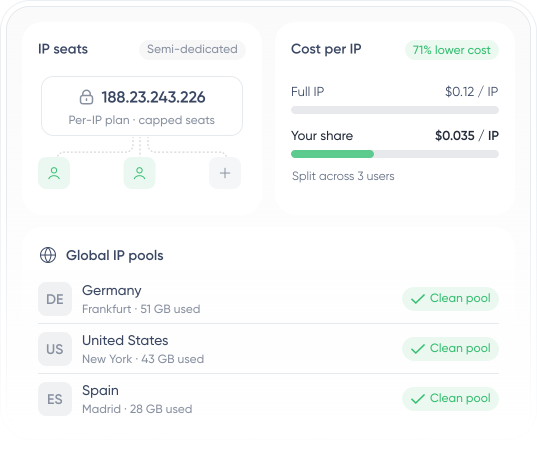
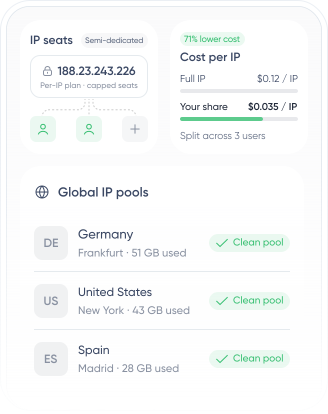
Each address in per-IP plans is capped at 1-3 users, which puts you close to exclusive use without the dedicated price tag.
Distributed pricing
Infrastructure overhead is spread among users, stretching your budget to pull more data without paying for isolation you don't actually need.
Same network under the hood
Shared proxies draw from clean IP pools across key global locations, built on the exact same core infrastructure as dedicated ranges.
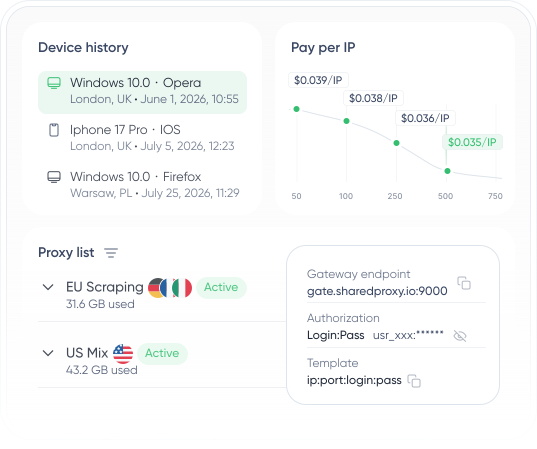
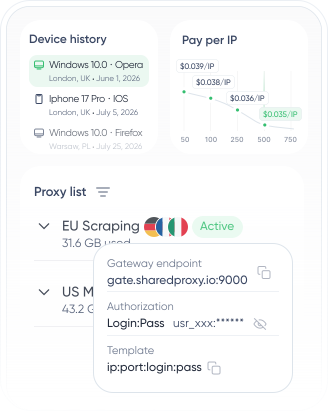
Stay in control of your proxy pool
Keep growing proxy lists organized with tags, searchable comments, and one-click exports formatted for your scraping stack. The dashboard puts IPs, orders, session controls, billing, and security into one workspace, with shareable proxy-list links that skip handing over your login.
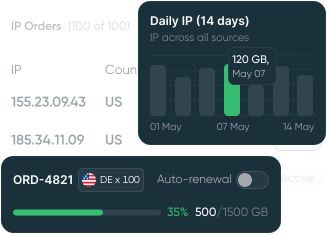
Track active, expiring, auto-renewing, and system-error proxies
Set up 2FA, manage IP allowlists, and review login history
See when adding more proxies lowers your price
Legally sourced datacenter IPs
Every IP in the shared proxy pool comes from direct agreements with Local Internet Registries and datacenter operators. Clean origin keeps trust scores high on target sites and prevents automation from breaking under sudden blocks.
Buy shared proxy access backed by uptime SLAs, sign-ready DPA and SCC agreements, and ISO/IEC 27001 certification in place before you send the first request.

Audit-ready standards built into the infrastructure
Shared proxy vs dedicated IPv4
Both give you access to the same proxy network, so decide whether you prioritize lower cost or full address control for your workload.Shared
Dedicated IPv4
Paid per IP
Paid per GB
Allocation
Shared among 1-3 users
Pooled
Exclusive, 1 user per address
Rotation
Static
Timed, on-demand, or sticky
Static
Geo-targeting
Country
Pool-wide / Country via endpoint
Country
Cost
Lower, split across tenants
Higher, full address cost
Bandwidth
Up to 1 Gbps
Up to 1 Gbps
Concurrency
Up to 100 connections per IP
Up to 100 connections per IP
Protocols
HTTP, HTTPS, SOCKS5
HTTP, HTTPS, SOCKS5
Best for
Bulk crawls, price monitoring, market research, SEO monitoring
Account management, QA, and other tasks requiring isolated IP history
Minimum order
50 IPs / month
3 GB / month
1 IP / week
Lowest price
from $0.27/IP
from $0.30/GB
from $0.49/IP

Not sure which proxy type fits your task best?
Share your use case, and we'll recommend the right proxy type in a few minutes.Connect a shared proxy server to your stack
Shared proxies support any stack that speaks HTTP(S) or SOCKS5, with authentication via username:password or IP allowlist. Scrapy, Puppeteer, Selenium, Requests, Playwright, and all major automation frameworks take a proxy string without special handling, so nothing about your existing setup changes.
API integration covers account management: place orders, check balances, export IP lists, and issue credentials straight from your code. Launch fast using native SDKs and ready-made snippets for Python, Node.js, PHP, Java, and Go.
See integration guidesimport requestsproxy = ("http://YOUR_LOGIN:YOUR_PASSWORD""@YOUR_PROXY_IP:YOUR_PORT")response = requests.get("https://httpbin.org/ip",proxies={"http": proxy, "https": proxy})print(response.json())
Customers’ choice
Shared proxies
Shared datacenter proxies with semi-dedicated access and reliable performance
1-3 users per IP
1 Gbps channel
99.7% uptime


Frequently asked questions
Shared proxies differ from dedicated proxies by allocation and price. A dedicated IP belongs to one customer for the rental period, while shared access splits a pool across multiple users. If your stack needs stable sessions, unlimited bandwidth, account logins, or whitelisted IPs, dedicated ISP proxies and other exclusive options are usually worth the extra spend. For large-scale scraping of public pages, cheap shared proxies typically provide far better unit economics.
Once cost efficiency points toward shared access, choosing the best shared proxy provider usually comes down to pool hygiene and support quality, since flagged subnets negate any price advantage.
Yes, for most collection work. Web scraping sends high request volumes to public pages, which is exactly the profile shared infrastructure is optimized for. Automatic IP rotation on per-GB orders can reduce ban exposure by spreading requests across the whole pool, while per-IP orders rely on splitting traffic across your purchased addresses. However, traffic distribution alone doesn’t guarantee success; client-side request handling matters just as much. Adding random delays, respecting target rate limits, and monitoring 403 and 429 response codes to tune concurrency usually reduce bans more effectively than simply buying a larger proxy pool.
Pairing economical proxy pricing for shared access with proper traffic pacing keeps a large data collection job from turning into a line-item negotiation. Targets that score IP reputation aggressively are the exception, and a separate dedicated proxy pool suits them better.
A standard free trial is not available, but enterprise teams can request a free proof of concept (POC) and run it against their own endpoints and volumes before committing a budget. We scope the pilot around your target requirements rather than handing over a generic test account. This lets technical teams assess success rates, latency, protocol compatibility, and integration with their existing scraping tools before full deployment.
All Proxy-Seller proxies support HTTP(S) and SOCKS5 on the same IP and port, so you switch protocols by changing the scheme in your client. You don't need new credentials or a separate endpoint. Residential, IPv4, and ISP proxies also carry UDP and QUIC (HTTP/3) traffic. HTTP(S) is the simpler choice for a standard crawler that only fetches web pages. Pick SOCKS5 for tools that send non-HTTP traffic. UDP and QUIC support matters when a target serves pages over HTTP/3 or your software relies on UDP-based protocols.
Yes, shared datacenter proxies can be detected, since exposure depends on the target's defense stack and user actions rather than the proxy itself. Aggressive IP-range and ASN checks catch them, though plenty of sites skip that layer entirely. More sophisticated anti-fraud systems look beyond IP subnets by stacking signals like IP reputation, request frequency, browser fingerprints, cookies, and TLS fingerprints.
Since a shared address carries the request history of everyone using it, targets running strict reputation scoring flag it more readily than a dedicated IP. Even a clean shared IPv4 can get blocked if request patterns look automated, so no proxy service can promise absolute block-free operation. Detection risk also depends on the task itself: for example, managing multiple accounts draws scrutiny through behavioral profiling regardless of proxy type.
Best practices reserve shared access with scalable infrastructure for high-volume collection work, whereas identity-sensitive sessions perform better on dedicated addresses or mobile proxies. Request pacing and session consistency matter equally: clients that maintain low concurrency, rotate IPs intelligently, and keep stable browser fingerprints typically get higher valid response rates than those relying solely on proxy-type switches or aggressive rotation.